
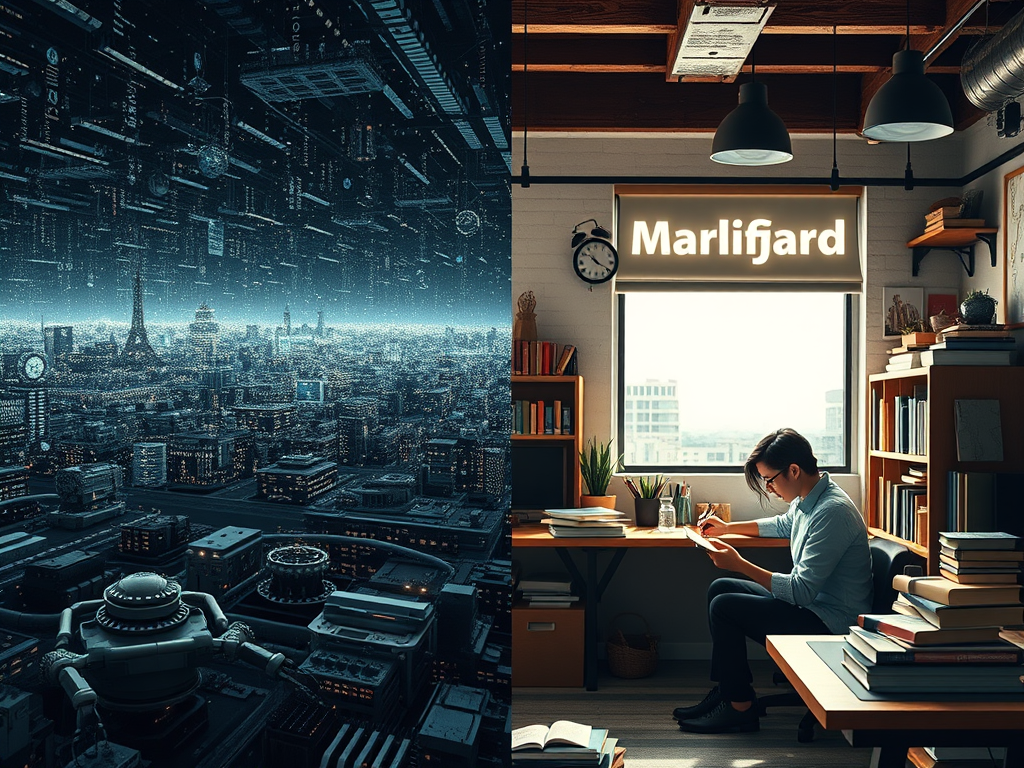
AI Content Farms vs. Authenticity: Where Do You Stand? 🧠
Introduction: When I Realized a Blog Wasn’t Written by a Human
I remember the exact moment I stumbled across an article that felt… off. It was about “10 Daily Habits That Boost Mental Clarity.” The layout was perfect, the SEO keywords were flawlessly placed, and yet, the tone was eerily hollow. It didn’t feel like someone had lived these habits. It felt like a machine had researched them.
Curious, I ran a few paragraphs through an AI detection tool. As expected—90% AI-generated.
That moment sent me down a rabbit hole: Are we heading toward a world where most online content is mass-produced by AI, devoid of real human experience? And even more importantly—is that a bad thing?
As someone who both uses AI and deeply values authentic storytelling, this tension feels personal. So today, I want to explore what AI content farms are, why they’re growing, and what’s at stake when we prioritize scale over soul.
I’ve seen friends get laid off from content marketing jobs, while their companies adopt AI-driven automation. I’ve seen passionate bloggers give up after their articles were buried beneath thousands of AI-written clones. On the flip side, I’ve also watched indie creators use AI to launch newsletters, novels, and course content with a freedom they never had before. This is not a simple story of man vs. machine—it’s a reckoning with the future of digital expression.
That’s when I began questioning my own approach. Was I using AI as a tool to support my creativity, or had I started relying on it to replace my intuition? I began looking more critically at my writing process, examining which parts were truly mine and which were algorithmically influenced. And the answer wasn’t always easy. Some of my best-performing posts were AI-assisted. But the ones I felt proudest of—those came from personal struggle, from emotional investment, from moments where I almost didn’t write at all.
So this exploration isn’t just theoretical—it’s deeply personal. I want to unpack what this shift means not only for the internet, but for creators like me and you who care about the why behind every word.
What Are AI Content Farms, Really?
AI content farms are systems or businesses that use automation—mainly large language models like ChatGPT—to generate huge volumes of digital content. We’re talking thousands of blog posts, product descriptions, and scripts per week, often published across multiple sites with minimal human oversight.
These farms use AI not just for speed, but for cost efficiency. No salary, no writer’s block, no vacation. Just constant, optimized output.
But this isn’t necessarily a dystopian takeover. Some content farms are transparent, labeling AI-generated content clearly and using human editors for polish. Others, however, operate in stealth, flooding the internet with indistinguishable machine-made content aimed only at ad revenue and SEO domination.
And that’s where things start to blur.
We’ve reached a point where even seasoned readers can’t always tell the difference between a blog post written by a person and one spat out by an algorithm. Sometimes, I catch myself reading a how-to article and wondering, “Did someone really struggle through this problem, or did an AI just guess based on Reddit threads and forum snippets?”
The volume of content being generated has grown exponentially, but quality hasn’t followed suit. Instead, users are finding it harder to locate genuine, heartfelt perspectives amidst a flood of sterile, keyword-heavy paragraphs.
Platforms like Google and Medium are trying to keep up—implementing better AI detection, penalizing low-quality pages—but the arms race is already on. Creators feel pressured to publish faster. Editors scramble to fact-check more. And readers are stuck wondering what’s real.
Some writers I’ve spoken to feel demoralized. They tell me that their nuanced think pieces are being outranked by generic listicles optimized by bots. “Why bother?” one blogger asked me. “If no one reads it anyway, what’s the point of putting in my soul?” It’s a valid question. And one that forces us to consider the value of writing not just for visibility—but for meaning.
There’s still a place for authenticity. A market, even. But it’s no longer the default. In a world where AI can mimic fluency and structure, emotional truth has become the new currency. That’s why I believe it’s more important than ever for writers to embrace vulnerability, specificity, and imperfection. Ironically, the very things AI struggles to replicate may be our greatest strengths.
Conclusion: Let’s Not Forget the Human Part
The internet doesn’t need more content. It needs more connection.
AI can generate paragraphs, but it can’t replicate your awkward laugh, your brokenness, your redemption arc. Only you can offer that.
Let’s not chase quantity and lose what made the web magical in the first place: real stories from real people.
Use the tools. But stay true to your voice. That’s what people will remember.
I remember when I published a vulnerable piece about my creative burnout—it barely had SEO optimization, and it wasn’t formatted for virality. But it got more personal messages than anything else I’d written that year. People didn’t want perfection; they wanted something real.
The more we lean into automation, the more precious authenticity becomes. You don’t need to go viral to matter. You just need to connect. Whether it’s with ten readers or ten thousand, your story—told honestly—is what cuts through the noise.
So the next time you hit “publish,” ask yourself: Is this content a reflection of me—or just a shadow of what I think the algorithm wants?
If we can center authenticity at the heart of our creative process, then AI doesn’t have to be the villain—it can be the assistant. The real danger lies not in the tools we use, but in forgetting who we are as we use them. And in a digital world craving realness, the simplest act of being yourself—honestly, vulnerably—becomes revolutionary.
When I look back at my own favorite pieces, none of them were perfect. Some had typos. Some wandered off-topic. But all of them carried pieces of my truth. That’s what readers responded to. That’s what stayed with them. Not the structure, not the keywords—but the humanity.
And maybe that’s the future we should aim for. A web not filled with more—but with more of us.
Leave a Reply